Find a credible use for generative AI within a broad, complex ERP ecosystem.
Generative AI · Enterprise product discovery
Making AI useful inside complex business software.
I shaped an AI-assisted communications experience for an enterprise ERP platform—turning a broad innovation brief into a focused, testable concept that kept people firmly in control.
New communicationDraft
What would you like to create?
Invite regional teams to the annual conference
↑ProfessionalWarmConcise
Refine toneReview draft →
LumiAI assistant · Ready
Human reviewYou approve every message
In your control
Role
UX Designer
Project
Gen AI discovery sprint
Duration
3 months · 2024
Focus
AI-assisted communications
Make AI approachable and useful without hiding uncertainty or removing user judgement.
An end-to-end tested prototype, assistant identity and guidance for future delivery.
Finding the right problem
Not “where can we add AI?”—where can AI genuinely help?
The initial brief was intentionally open. Rather than defaulting to a generic chatbot, I explored business workflows where generative capability could remove meaningful effort.
Communication creation emerged as the strongest opportunity: admins already had a clear goal, but drafting, refining and distributing messages could be slow and cognitively heavy.
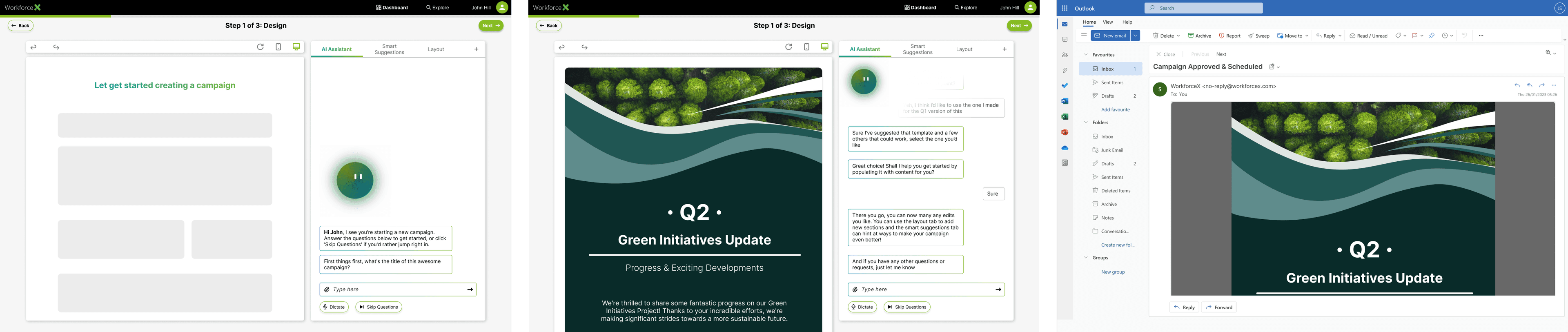
Prototype concept
One connected flow—from intent to reviewed communication
The prototype showed how an admin could brief the assistant, shape the output and preview the final communication before choosing to distribute it.
Design strategy
Build confidence through behaviour, not AI theatre.
Focus on a specific job
Anchor the AI in an existing communication task rather than presenting an empty chat box.
Show what the AI is doing
Use clear status, previews and conversational feedback to make the experience understandable.
Protect human judgement
Let users direct, edit and approve the output instead of automating consequential decisions.
Interaction modelAssistance without surrendering control
Human in the loop
Generate & refineAI proposes, user directs
Principle
Make AI capability visible, its status understandable and every consequential action reversible.
From ambiguity to prototype
Research, narrow, test, refine.
Reviewed emerging human–AI interaction patterns, trust signals and assistant behaviours.
Compared possible opportunities and focused the concept on communication generation.
Mapped the journey, moved from wireframes to realistic flows and tested the interaction.
Refined tone, personality and controls in response to feedback, then documented the direction.
Assistant identity
A little personality made an unfamiliar capability easier to approach.
Giving the assistant a clear identity helped users understand when they were interacting with AI. Testing shaped a presence that felt friendly and useful without becoming distracting or overly human.
Lumi is ready
Outcome
A concept stakeholders could believe in—and build from.
End-to-end prototype demonstrating a practical AI use case inside the ERP platform
Positive user response to the assistant’s clearer, more approachable personality
Figma iterations and visual guidance supporting consistency beyond the sprint
Senior stakeholder enthusiasm and plans to continue exploring the concept
“Your innovation, collaboration and passion is second to none.”
Senior stakeholder feedback
Reflection
This project taught me that designing for AI is as much about expectations as interface. Users need to understand what the system can do, retain control when it may be wrong, and feel confident about what happens next.