Make unfamiliar identity and document journeys feel secure without overwhelming a broad public audience.
Content design · Digital identity
Designing trust into a government digital wallet.
I shaped content across wallet, sign-in and identity-verification journeys, helping people understand why sensitive steps were needed and how to access verified government documents with confidence.
Role
Content Designer
Sector
Public sector
Product
Government digital wallet
Focus
Trust, identity & secure documents
Content options, journey guidance, cross-team iteration and structured handover across connected services.
Clearer explanations and instructions ready for review, sign-off, continuation and translation.
The service ecosystem
One user journey. Several secure services.
People could begin in a public service, move through GOV.UK One Login and identity verification, then return to access or add a document. Internally these were distinct service areas; to users they needed to feel like one coherent journey.
My role was to keep people oriented: where they were, why they had moved, what information was needed and what would happen next.

Connected journey
Mapping the handoffs around GOV.UK One Login
Understanding the wider ecosystem helped the team write content around the user’s task rather than the boundaries between internal services.
Content strategy
Trust is built one clear answer at a time.
At every sensitive moment, the content needed to answer the question already forming in the user’s mind.
Why do you need this?
Explain the purpose before asking for sensitive information or an unfamiliar action.
What should I do?
Turn verification requirements into short, practical and accessible instructions.
Is this secure?
Use calm, transparent language to show how verification protects access to documents.
What happens next?
Maintain continuity across service handoffs so people stay confident and oriented.
UnderstandWhy am I being asked?
VerifyProve it’s really you
AccessOpen your document
How I worked
Explore, compare, test and align.
Reviewed existing flows, research context and decisions after joining mid-project.
Found moments where reassurance, explanation or clearer instruction was essential.
Created alternative approaches to compare tone, clarity and confidence.
Iterated with the wider content team and prepared clearly labelled handover materials.

Verification guidance
Clear instructions for sensitive steps
Content needed to make unfamiliar actions achievable while setting accurate expectations.
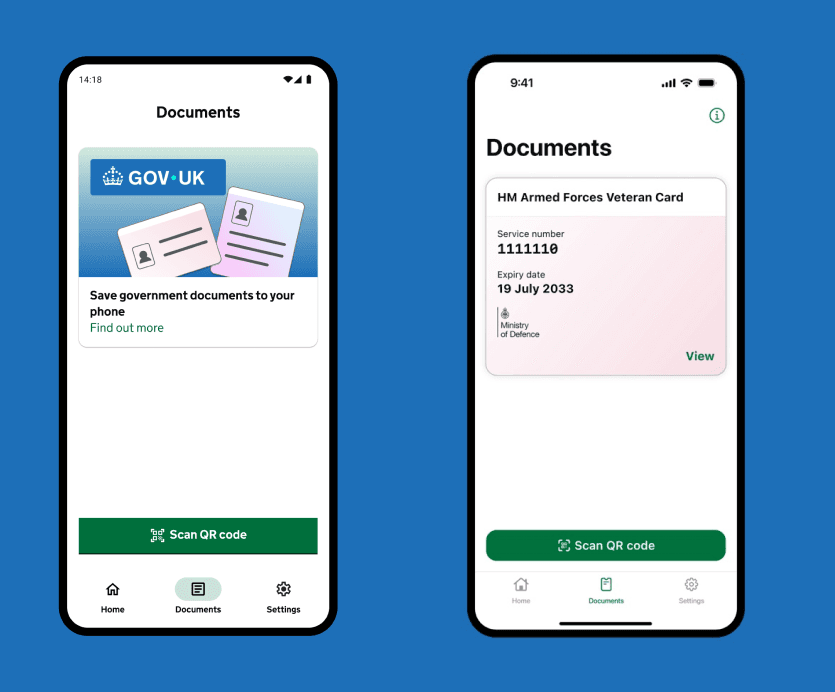
Verified documents
Making digital credentials understandable
The wallet introduced a new mental model: secure access to verified documents on a device.
Key decisions
Write for confidence, not internal logic.
Lead with the user’s goal
Service architecture stayed in the background; content focused on the task people were trying to complete.
Be transparent about verification
Clear explanations of why, what and next helped make security feel protective rather than obstructive.
Design for continuation
Structured Figma and Miro materials preserved context for in-house designers, reviewers and translation teams.
Outcome
Clarity across high-trust moments.
- Improved guidance around identity-verification tasks
- Strengthened explanations of secure document access
- Supported iterative review across the wider content team
- Prepared content for sign-off, handover and translation
- Kept connected service journeys focused on the user’s task
Reflection
High-trust content works best when it is calm, specific and timely. People do not need every technical detail; they need enough transparency to understand the request, feel in control and take the next step confidently.